In active operation
Youdian Banfa|WeChat content-to-tool loop
The Official Account turns confusing situations into actionable steps; the Mini Program then helps users organize material, check privacy and preserve an evidence timeline.
- WeChat Official Account
- WeChat Mini Program
- Local-first processing
- Product analytics
Evidence
Product loop
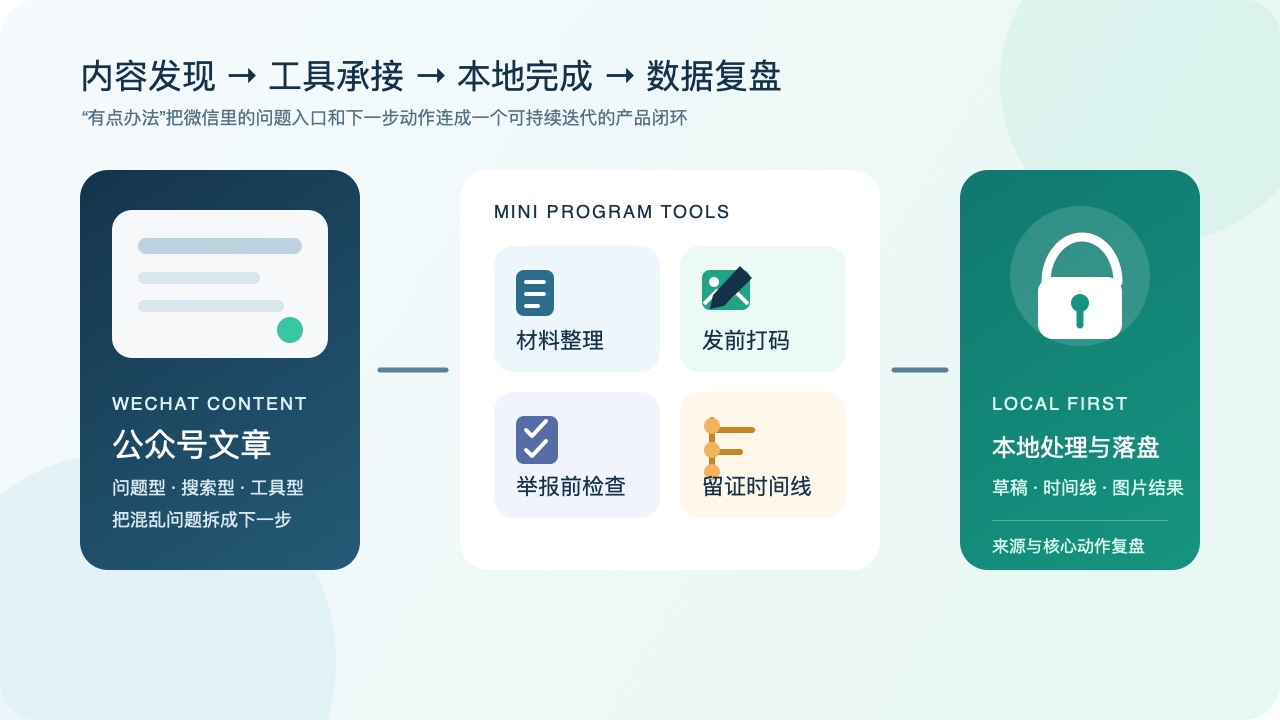
Content acquisition → tool completion → WeChat return visits
Recommendation and search traffic enter through an article, then move directly to the tool that matches the problem.
Reviewed sample
17 articles · 13,861 reads
The same sample recorded 443 shares and 58 saves, with a top article reaching 5,757 reads.
Mini Program source signal
74.19% of new users came from articles
In June 2026, the Official Account menu contributed another 24.19%, validating the split between acquisition and repeat entry.
Constraints and priorities
Articles lead to a specific next action
Each topic maps directly to material organization, image redaction, a pre-report checklist or an evidence timeline instead of dropping everyone on the home page.
Sensitive material stays inside a local-first boundary
V1 centers on local processing and storage without login, a complex account system or cloud material synchronization.
Sources and core actions close the feedback loop
Reviews connect article performance with entry source, destination page and completion actions such as generate, copy and save.
What I shipped
A content-to-tool mapping system
Problem, search and tool-oriented articles each route to the relevant feature so content explains the method and the Mini Program completes the action.
Four focused task tools
Material organization, image redaction, pre-report checks and evidence timelines remain separate so each visit has one clear job.
Local persistence for drafts and timelines
Unfinished material can be continued, while timelines and processed images remain on the user side without cloud material synchronization.
One review model for content and product
Article results, Mini Program acquisition sources and core completion events are reviewed together to guide both topics and feature priorities.
Case study
Background
Youdian Banfa addresses a class of situations that are common but difficult to structure. A user may already be dealing with a complaint, a report, exposed personal information or a pile of evidence, yet still be unsure what to do first or how to organize screenshots, links, dates and the desired outcome.
The product is deliberately not positioned as a service that judges a case or guarantees a result. Its fixed boundary is information organization and privacy reminders only: no legal advice, reporting on a user’s behalf, rights-enforcement service or promised outcome.
Product loop
The project runs through one path inside the WeChat ecosystem:
Recommendation traffic / WeChat search
        ↓
Youdian Banfa problem-oriented article
        ↓
The matching Mini Program entry
        ↓
Material organization / redaction / checklist / evidence timeline
        ↓
Return through the WeChat taskbar or Official Account menu
The Official Account breaks a confusing issue into steps, checklists and decision order. The Youdian Banfa Assistant Mini Program then supports the next concrete action. An article routes to the relevant feature instead of sending every user to a generic home page.
How the four tools divide the work
- Material organization structures what happened, available evidence, actions already taken and the desired outcome, with generation, copy and local drafts.
- Pre-publish redaction helps cover private details in screenshots or chat records and saves the processed result on the user side.
- Pre-report checklist checks commonly missed material for a selected situation and allows the result to be copied.
- Evidence timeline adds and edits events, then produces an ordered timeline that can be copied when more material is needed.
Keeping the tools separate gives each visit one clear job instead of presenting a single oversized form for every situation.
Local-first data boundary
V1 centers on local processing and local storage. Drafts, timelines and image-processing results persist on the user side, without login, a complex account model or cloud material synchronization. This is an intentional privacy boundary for sensitive material, not simply a missing feature.
Operational review uses aggregated entry and completion signals: content source, entry type, destination page, and actions such as generate, copy, save and checklist completion. The purpose is to learn which content actually brings a user to the right tool and whether the core task is completed.
My role
I own the product positioning, the Official Account content system, Mini Program feature design, article-to-page mapping and operating-data reviews. The work continuously connects three questions:
- What problem brings the user in?
- Which action should follow the article?
- Was that action actually started and completed?
Verified results
A reviewed sample of 17 articles accumulated 13,861 reads, 443 shares and 58 saves, with the top article reaching 5,757 reads. The same data showed that explicit search terms, decision-oriented titles and action order attract stronger demand than broad, loosely related topics.
Mini Program source data for June 2026 provided a second signal: 74.19% of new users came from Official Account articles and 24.19% from the Official Account menu. Articles handle problem discovery, while the menu provides a stable return path.
Next step
The next phase prioritizes better large-text support, continuation of unfinished work, clearer feedback after primary actions, and a more complete view from article entry to core-task completion rather than expanding the feature count.
Product and engineering decisions
Content acquires; the tool completes
The article answers what to do next, while the Mini Program helps the user actually complete that step.
No login or cloud sync in the first version
A smaller boundary reduces privacy overhead for sensitive material and lets the product validate its core tasks first.
Ads come after the primary action
A banner may remain, but it cannot block form entry, redaction, copy or save, and it is never a prerequisite for completing a task.
Outcome and review
Content is producing observable tool users
In June 2026, Official Account articles accounted for 74.19% of new Mini Program users, showing that content functions as a real acquisition entry.
Data narrowed the editorial direction
The 17-article sample showed that explicit search terms, decision questions and action order outperform broad safety topics, so the content line was tightened accordingly.
One project spans product, content and operations
Content structure, feature mapping, local data boundaries and source review operate as one maintained product system.