Abandoned · archived
AppShots
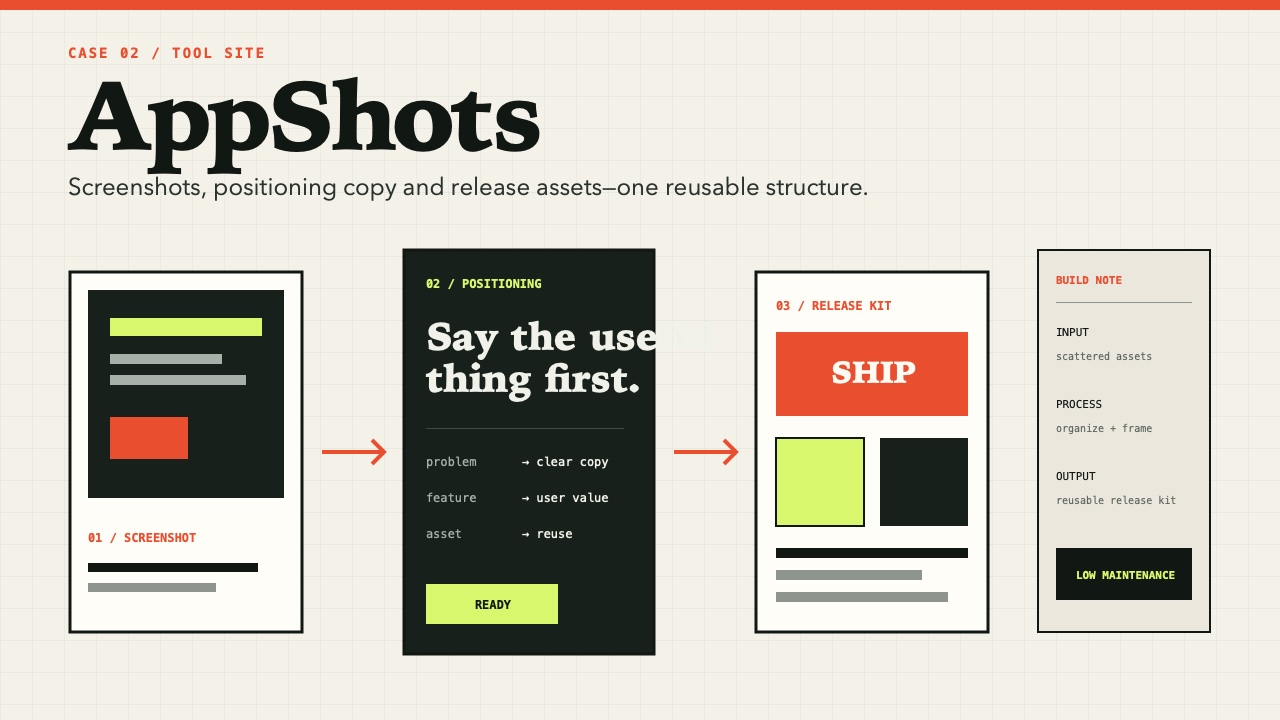
A lightweight tool-site project for organizing app screenshots, positioning copy and reusable release assets. No longer maintained; kept as a structural record.
- Flutter
- Node.js
- Asset organization
- Lightweight content architecture
Evidence
Project type
Tool-style presentation project (archived)
Built to help a small product explain itself more clearly without turning into a heavy platform. Development has been discontinued.
Archive reason
Direction abandoned; no further development
The expression structure and page patterns have been reused in later work. The standalone tool site itself is no longer maintained.
Delivery mode
Flutter + Node.js
A compact frontend and minimal backend support, enough to stay extensible without becoming bloated.
Constraints and priorities
It is not just a gallery
AppShots treats screenshots, positioning copy and presentation structure as one product surface.
It starts with a low-maintenance version
The project first validates clarity and public explanation before growing into something heavier.
It feeds the rest of the portfolio
The structure clarified here becomes the pattern for presenting other projects across the site.
What was explored
One structure for screenshots, copy and sequence
The scattered release assets were reorganized into one reusable explanation layer instead of repeated ad hoc documents.
A reusable project-card and detail-page pattern
The work here also defined the presentation pattern that can be reused across the rest of the portfolio.
A low-maintenance public delivery path
The implementation stays intentionally light so the project can remain useful without turning into a heavy publishing system.
Case study
Background
For many small teams, release screenshots, store copy and marketing assets live in too many separate places. Every time they need to be assembled again, someone has to pull them back out from design files, store dashboards, chat threads and temporary notes. AppShots starts by removing that repetition.
Problem it addresses
- Reduce repetition when screenshots and copy need to be prepared again and again.
- Give a small tool a clear public-facing explanation page.
- Reuse the same structure later for other portfolio projects.
Why the scope starts small
I intentionally did not begin by turning it into a feature-heavy platform. The first questions are simpler and more important:
- Can this project explain an app clearly?
- Can this structure be reused for other projects later?
If those questions stay blurry, a larger feature set only creates more noise.
My role
I used this project to shape positioning, page structure and delivery framing. It is less about shipping a feature-heavy tool and more about validating a compact, reusable way to present product work.
What I actually handled
- Turned screenshots, release copy and presentation order into one reusable structure.
- Built the first public-facing explanation skeleton so the project could be understood outside internal notes.
- Used the same work to define a repeatable pattern for other project pages on the site.
Key tradeoffs
- Keep the architecture light instead of introducing a heavier workflow too early.
- Prioritize clarity of the public page over feature count.
- Treat asset usage as part of the product design, not just a storage problem.
Current state
The project has been discontinued and is no longer maintained. The standalone tool site direction has been abandoned. This page is kept only as a historical build record — documenting the positioning, structural decisions and expression approach at the time. The method and information structure recorded here have since been reused in later projects, including this portfolio site.
Why it stopped
During development, it became clear that the maintenance cost of a standalone tool site did not match the resource priorities of the current phase, and its core expression structure had already been absorbed into subsequent work. The decision was made to stop independent development and focus effort on projects more directly tied to current operations.
Short reflection
AppShots is a good example of how I prefer to work: clarify the problem and the structure first, then keep the product boundary small and maintainable. Even though the project itself has stopped, that approach continues to shape subsequent work.
Decisions at the time
Clarify the explanation layer before platformizing it
If the public explanation is still blurry, adding more backend workflow only makes the product harder to maintain.
Prioritize clarity over feature count
At this stage, the useful win is helping someone understand the project quickly, not widening the surface area.
Let one project improve the rest of the site
AppShots is treated both as a project and as the structural testbed for the broader portfolio.
What remains useful
It validated a lighter way to present product work
Clarifying a project before expanding features was a better fit than jumping into a larger platform too early at the time.
It provided a reusable project-page skeleton
Background, problem, role, tradeoffs and status became a repeatable pattern through this project and has been reused in later work.
It treated presentation as actual product work
The page was never just decorative — it directly supported how the product was explained. The standalone tool site is now archived, but the method lives on.