Abandoned · archived
Privacy-first app
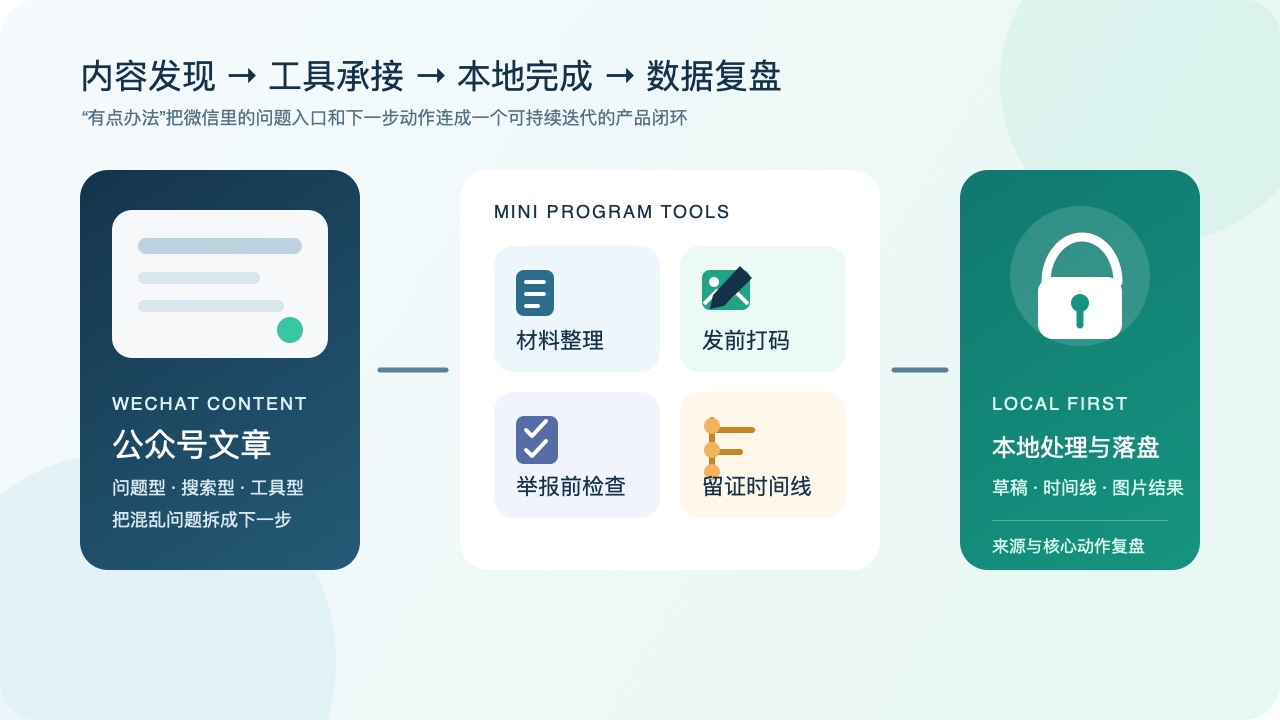
A discontinued privacy-first product exploration that put restraint, privacy boundaries and low-noise interaction ahead of feature volume. Kept only as a direction record.
- Flutter
- Local-first thinking
- Privacy design
- Small-product iteration
Evidence
Stage
Archived — no longer in progress
The direction has been stopped. Work on scope definition and the public explanation has been discontinued.
Core principle
Low-noise, privacy-first, boundary-aware
Not every possible feature belongs in the first version. These principles remain relevant as methodology.
Current scope
Structured record only
The page, image and route are preserved as a record of the direction exploration and trade-off decisions.
Constraints and priorities
Restraint came before expansion
The project started from a quieter experience, not a broader feature checklist.
Privacy affects the structure early
Privacy is treated as a product-shaping decision, not a note added after implementation.
The first version stays deliberately small
The goal is to prove the direction in a realistic scope before making it larger.
What was explored
A tighter first-version boundary
The exploration defined the smallest version that could have felt coherent and worth releasing.
A lower-noise interaction structure
Information hierarchy, pacing and user flow were shaped to stay quieter and more intentional.
A clearer public explanation of the privacy stance
The product boundary and privacy position were documented early instead of being retrofitted later.
Case study
Background
This project started from a simple observation: many apps keep adding features, but lose clarity around privacy, distraction control and product boundaries. I wanted to explore a more restrained alternative.
Problem it addresses
- Help users complete the core task with less noise.
- Avoid adding growth-oriented or attention-hijacking patterns too early.
- Make the project’s privacy stance explicit in the public explanation.
Key tradeoffs
- Prioritize what the first version genuinely needs instead of inflating the scope for completeness.
- Let privacy concerns shape the product structure early, not just the copy around it.
- Use a more restrained interaction model to validate the direction before adding more surface area.
My role
This was a self-directed exploration. I was responsible for the product direction, the Flutter implementation and the judgment around what should stay inside the first public version.
What I actually handled
- Defined what the first public version really needs in order to feel honest and usable.
- Used lower-noise interaction decisions to shape the information hierarchy and flow.
- Prepared the public explanation so the privacy position is visible before the product expands.
Current state
This direction has been stopped and is no longer being developed. This page is kept only as a structured record of the direction exploration and trade-off decisions — documenting the positioning, boundary judgments and first-version scoping process at the time. The page, image and route remain unchanged but do not represent an active or in-progress project.
Why it stopped
During the exploration phase, it became clear that the resource commitment required for this direction did not match current priorities, and the scope failed to converge into a clear enough public version that could be advanced independently. The decision was made to stop and refocus effort on projects more directly tied to current operations. The methodology around low-noise, boundary-aware and privacy-first design has been absorbed into subsequent product work.
Short reflection
This project keeps reinforcing the same lesson: a better product is often the one that refuses unnecessary complexity. That judgment still holds, even though the direction has been archived.
Decisions at the time
Avoid growth-heavy interaction patterns
Attention-hijacking prompts and non-essential nudges are intentionally kept out of the product surface.
Let privacy shape the structure early
The product boundary is decided during information and interaction design, not after implementation is already fixed.
Keep the first version inside a realistic delivery scope
A smaller but coherent version is more valuable than a broad first release that loses its position.
What remains useful
It shows how I judge product boundaries
The first question is not what else can be added, but what should stay out for now. This framework remains valid after the direction stopped.
It validated low-noise interaction as a methodology
Less friction and fewer attention-hijacking patterns make the core intent easier to see. This insight was formed during the exploration phase.
Preserved as a direction and trade-off record
The first version did not reach a public stage and the direction has been stopped. This page keeps the structural reasoning from that phase, not as an active project.